If you have started gathering quotations for a private label or OEM instant noodle project, you have probably noticed something confusing. One supplier says 200 cartons. Another says 1,000. A third asks three questions about your specification before they will commit to any figure at all. The temptation is to treat this as a simple comparison and go with the lowest number. That is usually a mistake, and it is one of the more expensive mistakes a new brand owner can make in this category.
The MOQ figure on its own tells you almost nothing. Two suppliers can quote the same minimum and be offering completely different things, and a supplier quoting a very low minimum is often doing so for reasons that will cost you later, either in unit price, in product quality, or in your ability to control your own brand.
This guide explains what MOQ actually means in instant noodle manufacturing, the real costs that set it, what a realistic minimum looks like, and how to work out whether your business is ready to place an order of that size.
What MOQ means in instant noodle manufacturing
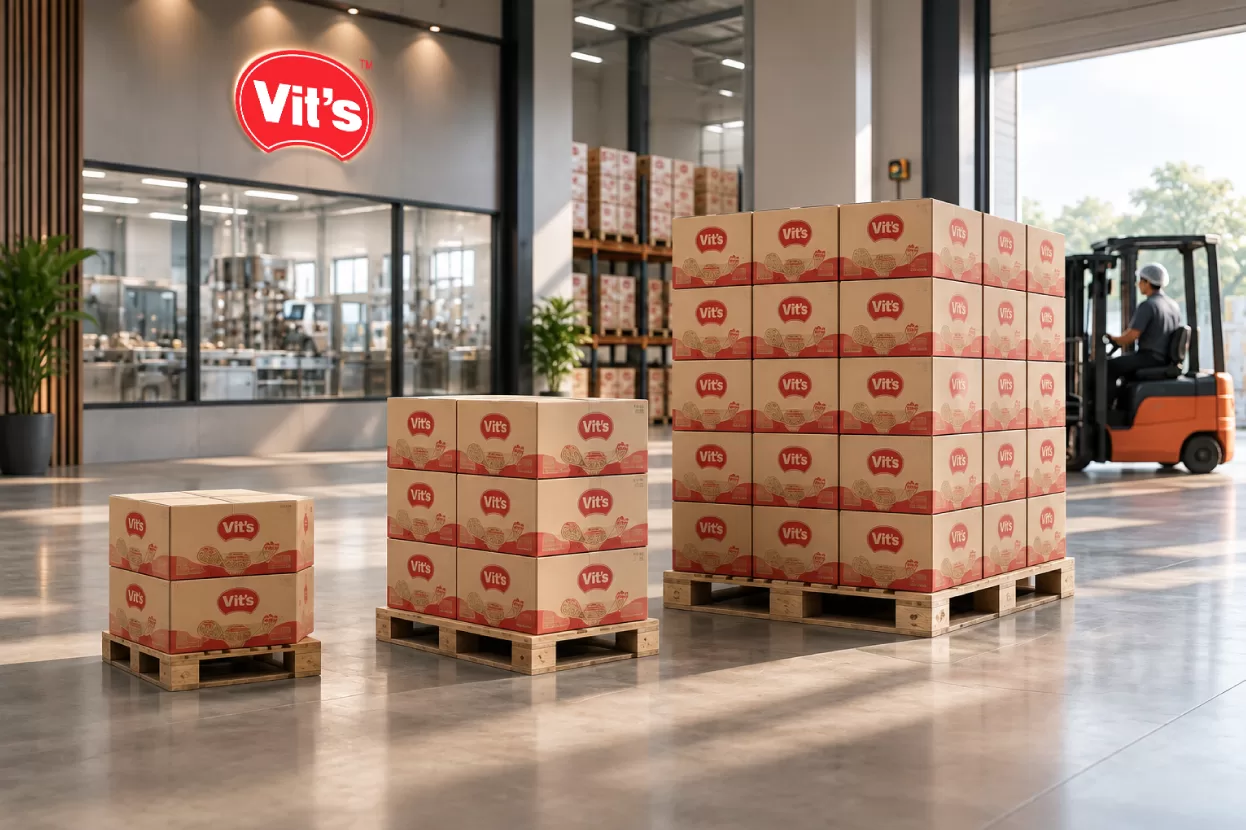
Minimum order quantity is the smallest production run a manufacturer will accept for a given product. In the instant noodle category it is almost always quoted in cartons rather than packs, because cartons are the unit used for palletising, warehousing, freight and distribution.
Carton counts vary by format. Depending on pack weight and packaging type, a single carton commonly holds somewhere between 24 and 30 individual packs. Cup and bowl formats usually hold fewer units per carton because of their shape.
It is worth being clear about what MOQ is not. It is not a sales target, and it is not a figure designed to make a manufacturer's life easier at your expense. It is the point at which a production run becomes viable for both parties. Below that threshold, the fixed costs of setting up the run are spread across so few units that the cost per carton becomes uncompetitive, which tends to leave the buyer with a product they cannot price sensibly on shelf.
Why MOQs exist: the four costs that actually set the number
Most first-time brand owners assume MOQ is driven by production capacity. It rarely is. Running noodles through a line is the easy part. The costs that set the minimum are the ones that happen before a single noodle block is produced, and they are largely fixed regardless of how many cartons you order.
1. Packaging film
This is the constraint most buyers have never heard of, and it is often the largest single factor. It is also one of the reasons the true cost of launching an instant noodle brand is usually higher than first-time founders expect.
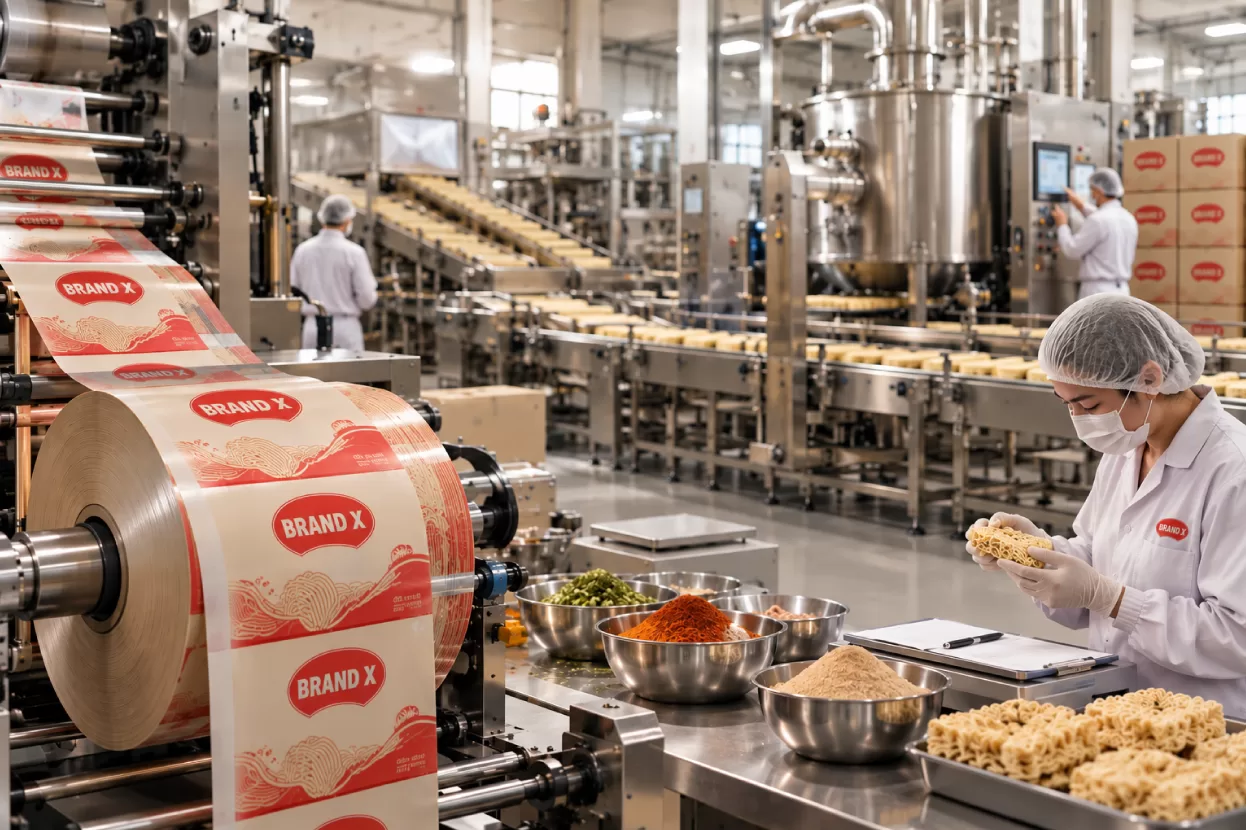
Instant noodle packaging is printed on flexible film using rotogravure printing. The process requires engraved cylinders to be produced for your artwork, and those cylinders are a one-time cost per design. Printers also impose their own minimum roll lengths, because setting up a press, matching colours and running it up to consistent quality consumes a meaningful quantity of film before the first usable metre comes off.
The practical result is that film cannot be economically printed in small quantities. A short run does not cost proportionally less. It costs almost the same as a much larger run, spread across far fewer packs.
2. Seasoning and flavour development
If you are developing a custom flavour rather than using an existing formulation, the seasoning is produced as a bespoke blend. Flavour houses and seasoning suppliers apply their own minimum batch sizes, and those minimums exist for the same reason: mixing, testing and validating a blend involves fixed effort that does not scale down.
Custom seasoning also requires development work before production. Sample rounds, sensory evaluation, adjustment and sign-off all take time and cost money, and that cost sits with the product regardless of how many cartons eventually get made.
3. Line changeover and downtime
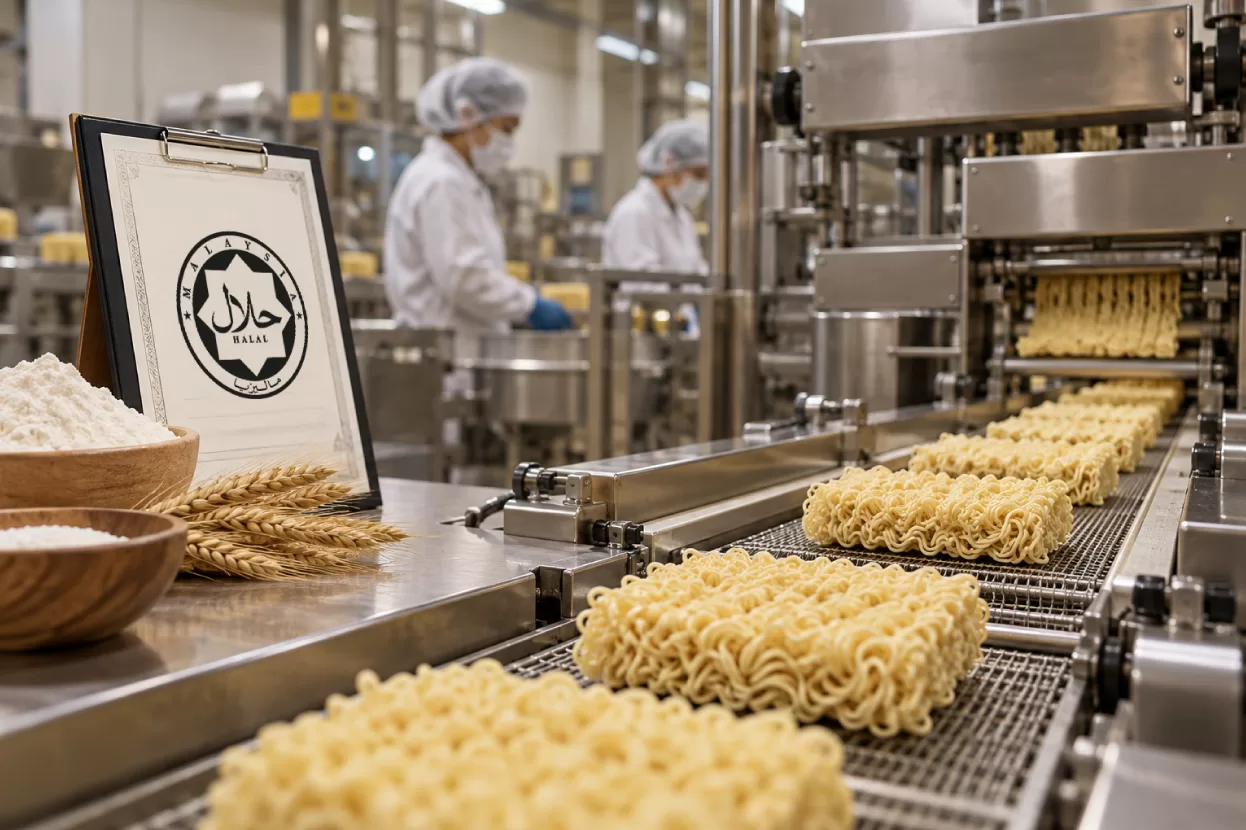
Switching a production line from one product to another is not instant. The line has to be cleaned down, seasoning systems flushed and changed over, packaging film loaded and registered, weights and seals verified, and the first output checked before saleable product starts coming off.
That changeover consumes the same hours whether the subsequent run produces 200 cartons or 5,000. For a manufacturer, a very short run can mean more time spent changing over than producing, which is why short runs carry a disproportionate cost.
4. Quality assurance, certification and documentation
Every product carries its own compliance workload. Nutritional analysis, shelf life validation, ingredient documentation, labelling review against the regulations of your target market, and Halal certification requirements all apply per product, not per carton.
For export orders this workload increases. Different markets have different labelling rules, permitted ingredient lists and documentation requirements, and each one has to be satisfied before the product can legally be sold.
Why a very low MOQ is usually a warning sign
If you have been gathering quotations, you may have come across suppliers offering minimums far below 1,000 cartons. It is worth understanding what is usually happening in those cases, because the low number rarely means what buyers hope it means.
It may be a relabelling exercise rather than manufacturing. The most common way to offer a very low minimum is to take an existing generic product, apply your branding, and sell it to you as private label. There is nothing inherently wrong with this, and for some buyers it is a reasonable entry point. But you are not getting a product developed for your brand. You are getting a product that may also be sold to your competitors under a different name, with no control over recipe, specification or continuity of supply.
The cost may be recovered elsewhere. Fixed costs do not disappear because the MOQ is lower. If they are not covered in the order quantity, they are covered in the unit price, in tooling and setup charges billed separately, or in a specification that has been quietly simplified. Buyers often discover this when they compare landed cost per carton rather than headline MOQ.
The supplier may be an agent rather than a manufacturer. Trading companies and sourcing agents can quote attractive minimums because they are aggregating orders or drawing from existing stock. This adds a layer between you and the factory, which matters when you need to resolve a quality issue, adjust a specification, or scale up quickly.
None of this means a low MOQ is always a bad deal. It means the MOQ figure on its own tells you very little. The questions that matter are whether you are dealing with the actual manufacturer, what the total landed cost per carton is, and whether the product is genuinely yours. This is the same pattern we see in pricing more broadly, where the lowest manufacturing cost rarely delivers the best margin.
So what is a realistic MOQ?
At Vit's, our minimum order quantity typically starts from 1,000 cartons, depending on the complexity of your requirement.
That figure reflects the cost structure described above rather than a commercial preference. It is the point at which the fixed costs of film, seasoning, changeover and compliance are spread across enough units for the product to reach shelf at a price that works for you.
Is 1,000 cartons actually a lot?
It sounds like a large number in isolation. It is worth testing it against what your distribution plan would need to absorb.
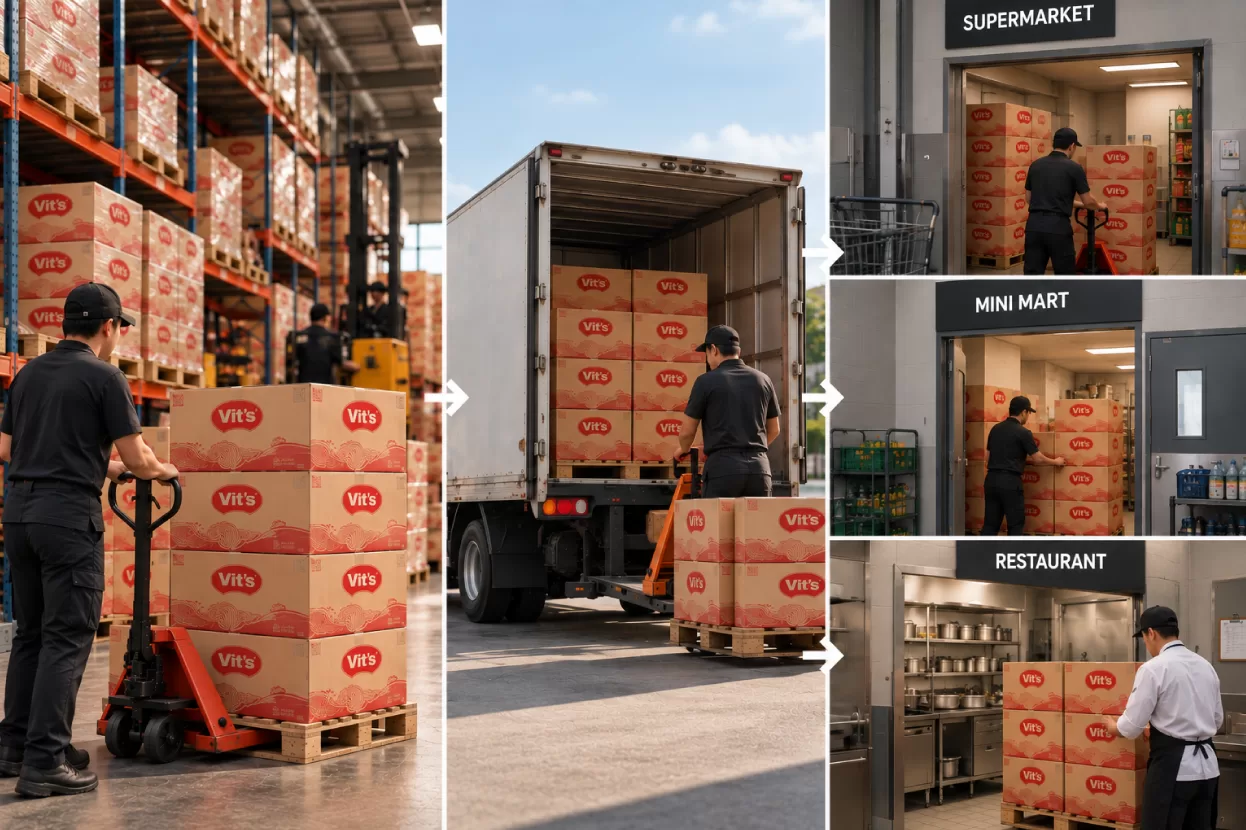
Spread across 100 retail outlets, 1,000 cartons is 10 cartons per outlet. Across 200 outlets it is five. For a brand entering a supermarket chain, a regional distributor network or a mini market group, those are modest per-store volumes, not ambitious ones.
If you are selling online or through a direct channel, the arithmetic is different but the principle holds. Work backwards from a realistic monthly sales rate and ask how many months of cover 1,000 cartons represents. For most brands with a defined route to market, the answer is a normal stockholding period rather than an unreasonable commitment.
This is the more useful question to sit with. If you cannot yet see how 1,000 cartons would move, the constraint is not the manufacturer's minimum. It is that the route to market has not been built yet. A supplier offering you 200 cartons would not have solved that problem. It would only have meant buying a smaller quantity of stock that still has nowhere to go, while spending the development budget you will need when the distribution is actually in place.
The brands that succeed in this category almost always secure distribution commitments before they commit to production, not after. If you are still mapping out that stage, our guide on how to launch and scale a private label instant noodle brand covers the sequence in more detail.
What affects your MOQ
The figure is not fixed for every project. Complexity moves it, and the main variables are worth knowing before you make an enquiry.
Product format. Pack, cup and bowl formats have different packaging requirements, different line configurations and different material minimums.
Recipe specification. An existing formulation carries less development overhead than a fully custom recipe with a bespoke seasoning profile.
Packaging specification. The number of colours, finishes and structural requirements in your packaging affects material costs and print setup.
Target market. Export orders bring additional labelling, documentation and certification requirements that domestic orders do not. Our guide on how to export your own noodle brand from Malaysia sets out what is involved.
Order continuity. A one-off run and an ongoing supply arrangement are commercially different propositions, and that is usually reflected in how a quotation is structured.
The most productive approach is to bring your actual requirement to the conversation rather than asking for a generic quotation. A manufacturer can give you a far more useful answer when they know what you are actually trying to build.
It is also worth remembering that sampling and commercial production are handled separately. Product development and samples are a standard part of the process, so you will have the opportunity to evaluate the product before committing to a production run.
What to prepare before you approach a manufacturer
Buyers who arrive with these four things get accurate quotations quickly. Buyers who do not tend to spend several weeks in exploratory conversation.
- Your target market and channel. Domestic retail, export, e-commerce, foodservice or institutional. This affects specification, labelling and packaging before anything else.
- Your product concept. Format, approximate pack weight, flavour direction, and any dietary or certification requirements such as Halal, vegetarian or specific ingredient exclusions.
- Your volume expectation. Not just the first order, but an honest view of what the following 12 months might look like.
- Your timeline. Product development, packaging artwork, film printing, trial runs and certification all take time. Working backwards from a launch date is more realistic than working forwards from an enquiry.
Frequently Asked Questions from B2B Buyers
What is the MOQ for private label instant noodles at Vit's?
Our MOQ typically starts from 1,000 cartons, depending on the complexity of your requirement. Speak to our team with your specification for an accurate figure.
How long does it take from enquiry to delivery?
It varies with specification. Product development, packaging artwork approval, film printing, trial production and certification each take time, and export documentation adds to the timeline. Bring your target launch date to the conversation and we can work backwards from it.
Do you manufacture Halal certified products?
Yes. Vit's has been producing Halal certified instant noodles since 1980, which is a requirement for the Malaysian domestic market and an advantage in many export markets.
Talk to us about your requirement
If you are planning a private label or OEM instant noodle project, the most useful next step is a conversation about your specific requirement rather than a generic quotation.
Vit's has been manufacturing instant noodles in Malaysia since 1980, producing for our own brand alongside OEM and private label partners in domestic and export markets. You can read more about our instant noodle manufacturing capabilities, or get in touch with your product concept, target market and volume expectations and our team will come back to you with a realistic assessment of what your project involves.