
Most articles about starting an instant noodle brand dramatically underestimate the capital required. They often focus on the ex-factory cost of a packet, multiply it by an estimated quantity, and assume the business is financially viable. While this method appears logical on paper, it rarely reflects the operational reality of launching a private label or OEM instant noodle brand.
In practice, the true cost of launching an instant noodle brand is shaped by a network of interconnected expenses that go far beyond manufacturing price alone. If you are sourcing through an OEM factory in Malaysia, Thailand, Vietnam, China, South Korea, or Indonesia, the capital required is influenced not only by the noodles themselves, but also by packaging tooling, ingredient batch requirements, freight costs, compliance processes, inventory commitments, and retailer payment cycles.
For many founders, the most costly mistake is launching multiple flavours too early. Every flavour introduces its own packaging run, seasoning batch, regulatory documentation, and inventory exposure. What initially appears to be a manageable launch quickly expands into a significantly larger financial commitment than anticipated.
Understanding how to calculate the true cost of launching an instant noodle brand allows founders to make informed decisions before placing their first OEM order. More importantly, working with an experienced manufacturing partner can help navigate these complexities with greater confidence and financial clarity.
The First Number You Need Is Not Cost Per Packet
When speaking to a private label noodle factory, most founders begin with a familiar question: What is your price per packet?
While this question feels natural, it is rarely the most useful starting point during the early planning phase. A factory may quote USD0.20, USD0.50, or USD0.78 per packet depending on the recipe, noodle format, packaging type, and order quantity. However, these figures alone do not reveal how much capital is actually required to launch the brand successfully.
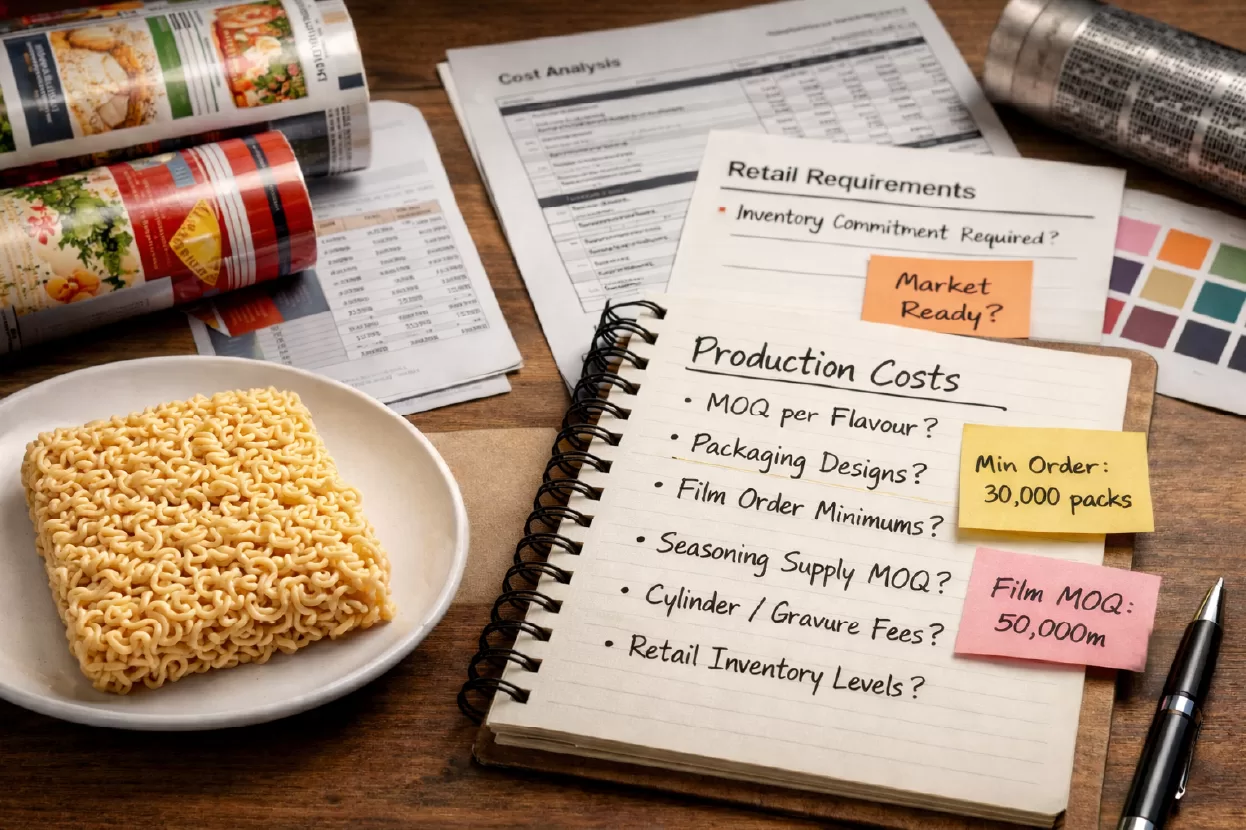
The more important questions usually involve production structure rather than price alone. Founders should be asking what the minimum production quantity is per flavour, how many packaging designs are required, whether printed film minimum order quantities exceed noodle production quantities, and whether cylinder or gravure charges apply. It is also necessary to determine whether seasoning suppliers require separate minimum runs and how much inventory must be committed before retailers consider the product commercially viable.
For most OEM instant noodle projects, startup cost is determined by the total capital required to sustain the first two production cycles rather than the gross margin on a single packet.
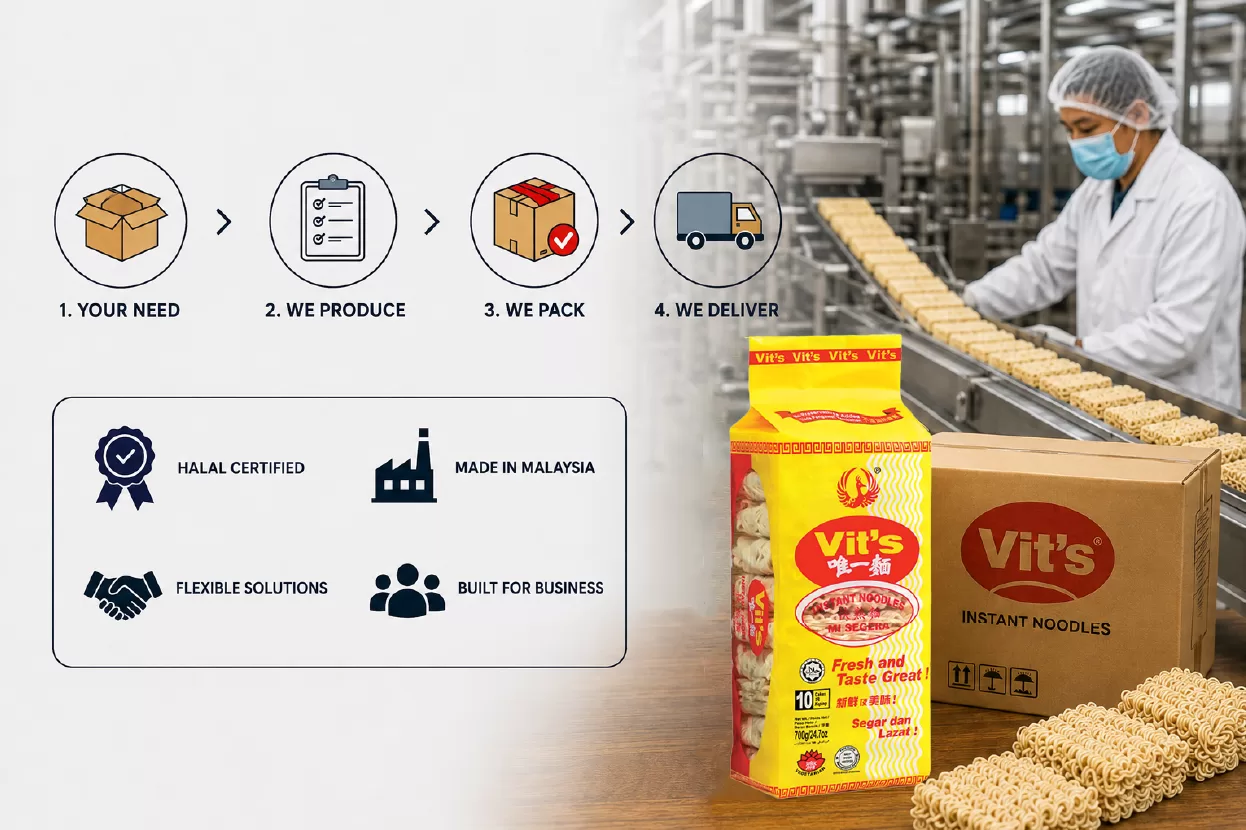
This is where experienced manufacturing partners play a significant role. Companies such as Vit’s have worked with private label and OEM clients across multiple markets and understand that founders often require guidance beyond basic unit pricing. Instead of focusing solely on cost per packet, experienced teams help founders map the broader financial structure needed to support production, packaging, compliance, and distribution.
Having the right technical and commercial support during this early stage can prevent miscalculations that might otherwise surface later as unexpected financial pressure.
Understanding the Real MOQ Structure in Instant Noodle OEM Manufacturing
The typical OEM noodle factory does not simply manufacture a small mixed batch of products and ship them immediately. In reality, production relies on multiple overlapping minimum order quantities that are tied to different components of the finished product.
These minimum order quantities commonly include noodle production volume, seasoning powder batches, oil sachet production, printed wrapper quantities, master carton production, and freight efficiency thresholds. Each component has its own manufacturing constraints, which must be considered together rather than independently.
For example, a factory may initially indicate that the minimum order is 10,000 packs per flavour. On the surface, this number appears manageable for a new brand testing the market. However, deeper investigation often reveals that the printed film supplier may require 30,000 wrappers, the seasoning manufacturer may require 25,000 sachets, and the carton supplier may require a minimum number of cartons per design.
Additionally, OEM manufacturers sometimes recommend producing multiple flavours within a single run to optimise production efficiency. As a result, a launch that was initially planned for 10,000 units may expand into a 30,000 to 50,000 unit commitment once all production layers are considered.
A realistic startup budget therefore begins by mapping every MOQ layer, not just the primary noodle production requirement.
Manufacturers with extensive OEM experience, such as Vit’s, often assist founders in visualising these layered MOQ structures before confirming final production commitments. This structured planning allows founders to reduce unnecessary packaging waste, align SKU selection with available capital, and avoid committing to volumes that exceed realistic demand forecasts.
Rather than reacting to MOQ constraints after production begins, early-stage planning ensures that cost exposure remains controlled and predictable.
Example: The Real Cost of a Three-Flavour Launch
To illustrate how quickly costs accumulate, consider a scenario where a brand plans to launch three SKUs at the same time.
Assume the selected flavours are Spicy Korean Chicken, Curry Laksa, and Black Pepper Seafood. The OEM manufacturer provides a quotation of USD0.48 per packet, with a minimum production requirement of 10,000 packets per flavour.
At first glance, the calculation appears simple. Producing 30,000 packets at USD0.48 per packet results in a total manufacturing cost of USD14,400. Many first-time founders stop their budgeting process at this stage, assuming that this figure represents the bulk of the capital required.
However, once supporting expenses are added, the true launch requirement becomes significantly higher. In reality, multiple cost layers contribute to the final startup budget, including packaging setup, logistics, compliance, and working capital reserves.
A more realistic cost breakdown for this three-flavour launch may look as follows:
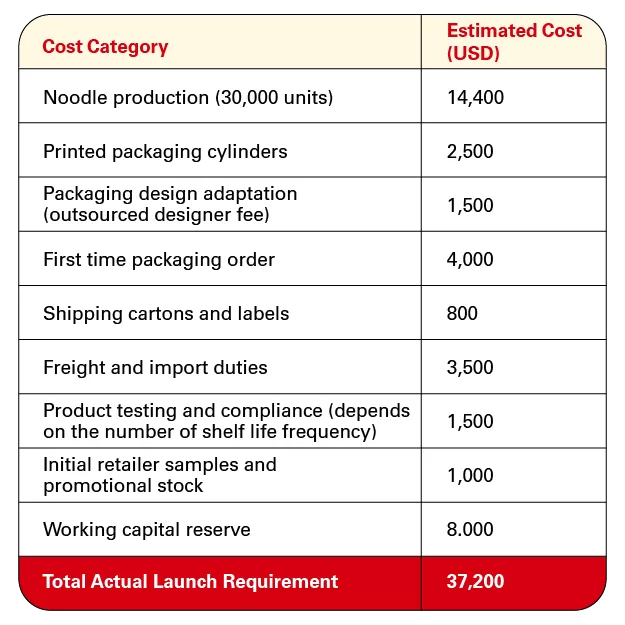
When viewed in this structured format, it becomes clear that manufacturing cost represents less than half of the total launch capital required.
This distinction is critical. Many instant noodle startups fail after their first production run not because their product lacks demand, but because they allocate nearly all available capital to production inventory while leaving insufficient funds for freight, compliance, retailer payment delays, or replenishment orders.
Experienced OEM partners such as Vit’s help founders visualise this complete financial structure before production begins. By identifying secondary costs early, founders are able to budget more accurately, avoid unnecessary financial strain, and maintain operational continuity beyond the first shipment.
Why Product Testing and Compliance Cannot Be Ignored
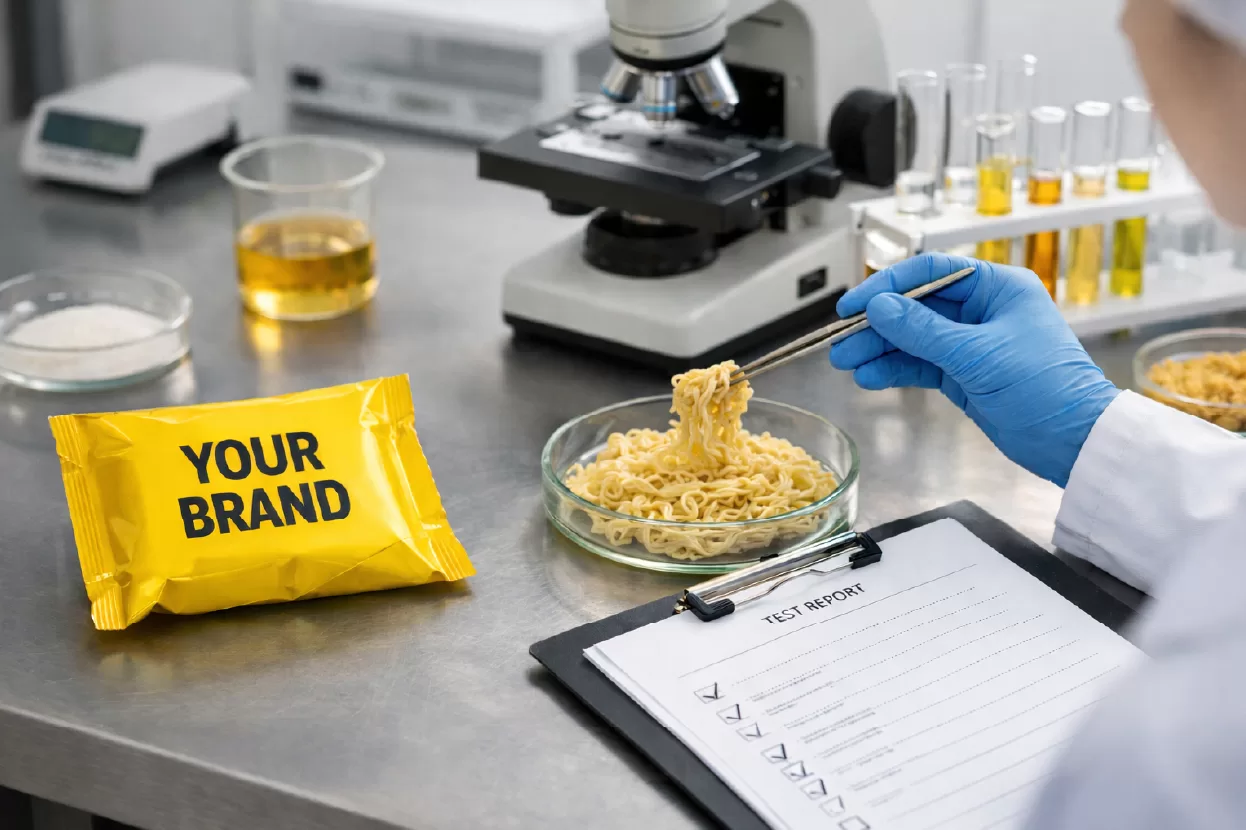
Another major area of financial risk involves regulatory compliance and product validation. Many new founders assume that OEM manufacturers automatically manage all compliance requirements. In reality, while manufacturers provide product specifications, the brand owner remains responsible for ensuring that the final product meets regulatory standards in the target market.
Depending on distribution location, founders may need to complete nutrition facts validation, shelf-life testing, import compliance certification, halal certification under their own brand, barcode registration, trademark registration, and product registration with relevant authorities.
Shelf-life testing is particularly important because it determines how long a product can remain safe and maintain quality while staying on the market. In many cases, testing may be conducted at regular intervals for up to 18 months to evaluate product stability over time and establish a reliable expiry date. The higher the testing frequency, the more data points are collected, which improves accuracy but also increases testing costs. As a result, founders should factor shelf-life testing expenses into their early product development budgets rather than treating them as optional costs.
If noodles are exported into markets such as Malaysia, Singapore, Australia, the Gulf region, Europe, or the United States, each region may impose different labelling requirements. Certain flavour enhancers may require specific declaration formats. Imported meat ingredients may require additional certification documentation. Some countries mandate defined allergen labelling structures, while export packaging may require bilingual presentation.
Many founders discover these requirements only after packaging materials have already been printed. When this occurs, packaging must be redesigned and reprinted, creating delays, unnecessary inventory loss, and increased launch costs. A responsible startup budget should include at least five to ten percent contingency allocation specifically for compliance adjustments.
Manufacturers with strong regulatory experience, such as Vit’s, typically provide guidance on documentation and labelling requirements early in the packaging development phase. Early verification significantly reduces the risk of regulatory non-compliance and minimises the likelihood of packaging redesign costs.
Packaging Costs Are Often Higher Than Expected
For instant noodle brands, packaging is rarely limited to visual design alone. Packaging often requires technical preparation, specialised printing methods, and physical tooling that increases initial setup cost.
Many OEM factories use rotogravure printed film for packaging. This process requires cylinder creation, colour separation, and material calibration. Each flavour typically requires its own cylinder set, which means packaging cost increases as SKU count grows.
Additionally, packaging suppliers often enforce minimum print quantities that exceed initial production volume. If only a portion of printed packaging is used in the first production cycle, the remaining materials must be stored for future use. Any later changes to product formulation, branding details, or regulatory information may render unused packaging obsolete.
Experienced manufacturers often advise founders to simplify packaging during the initial launch phase. Strategies such as limiting colour complexity, reducing SKU count, or using adaptable packaging formats help control early-stage cost exposure.
Guidance from experienced OEM partners helps ensure that packaging decisions align with realistic launch objectives rather than purely aesthetic preferences.
Freight and Logistics Must Be Calculated Carefully
Freight expenses are frequently underestimated during startup budgeting. When importing noodles from overseas manufacturers, freight structure plays a major role in determining final landed cost.
Many startup orders are too small to fully optimise container space, which results in less-than-container-load shipping. This method increases per-unit transport cost compared to full container shipping.
Additional expenses may include port handling fees, customs brokerage services, import duties, local transportation, unloading charges, and short-term storage costs.
These costs often increase landed product cost by fifteen to thirty percent. Without accurate freight estimation, pricing models may appear profitable during planning but become unsustainable during execution.
Working with experienced manufacturers helps forecast freight structure more accurately and identify cost-saving opportunities during shipment planning.
The Importance of Working Capital and Second Production Cycles
One of the most overlooked financial risks in instant noodle manufacturing involves payment timing rather than manufacturing cost. Most retailers operate on delayed payment terms that extend thirty, sixty, or ninety days after product delivery.
This delay creates a financial gap between production payment and revenue collection. During this period, inventory may already be selling while replacement production orders must be placed.
Without sufficient working capital, businesses may run out of stock precisely when demand begins to increase.
Responsible startup budgeting therefore includes funding not only for the first production run but also for the second production cycle and several months of operating expenses.
Manufacturers with strong OEM experience often assist founders in planning these production cycles realistically. Companies such as Vit’s understand the financial timing challenges associated with retail distribution and help clients structure production schedules that reduce the risk of supply interruptions.
A More Realistic Startup Budget Range
When all cost components are considered together, realistic startup budgets typically fall into structured financial ranges.
A single-flavour pilot launch that focuses on online distribution may require between USD15,000 and USD30,000. A small retail launch involving two to three SKUs may require between USD40,000 and USD80,000. Regional supermarket expansion involving multiple flavours and broader distribution networks may require between USD100,000 and USD250,000 or more.
These ranges reflect cumulative investment across production, packaging, compliance, logistics, marketing, and working capital reserves.
They represent practical operational realities rather than simplified theoretical estimates.
Why Experience Matters When Launching an Instant Noodle Brand
Launching an instant noodle brand involves far more than selecting flavours and placing production orders. It requires coordination across manufacturing, packaging development, compliance validation, logistics planning, and working capital management. Each stage introduces decisions that directly affect cost, timeline, and long-term sustainability.
Founders entering the private label and OEM space for the first time often underestimate how interconnected these decisions are. A change in packaging design can influence MOQ requirements. A delay in certification can affect shipping schedules. A miscalculated production volume can disrupt retailer supply continuity.
These challenges are manageable when supported by experienced personnel who understand the full lifecycle of instant noodle manufacturing.
Vit’s has built its OEM and private label capabilities through decades of manufacturing experience, supported by dedicated technical, regulatory, and commercial teams. Rather than functioning solely as a production facility, the organisation provides structured support across multiple stages of product development, from formulation and packaging planning to certification and distribution preparation.
For founders navigating the complexities of launching an instant noodle brand, having access to experienced professionals who understand these operational realities significantly reduces risk. More importantly, it improves the probability that early production runs translate into long-term brand growth.
Ultimately, the true cost of launching an instant noodle brand is not simply the cost of producing noodles. It is the cost of navigating complexity without preparation. With the right planning and the right people involved, that complexity becomes manageable and predictable.