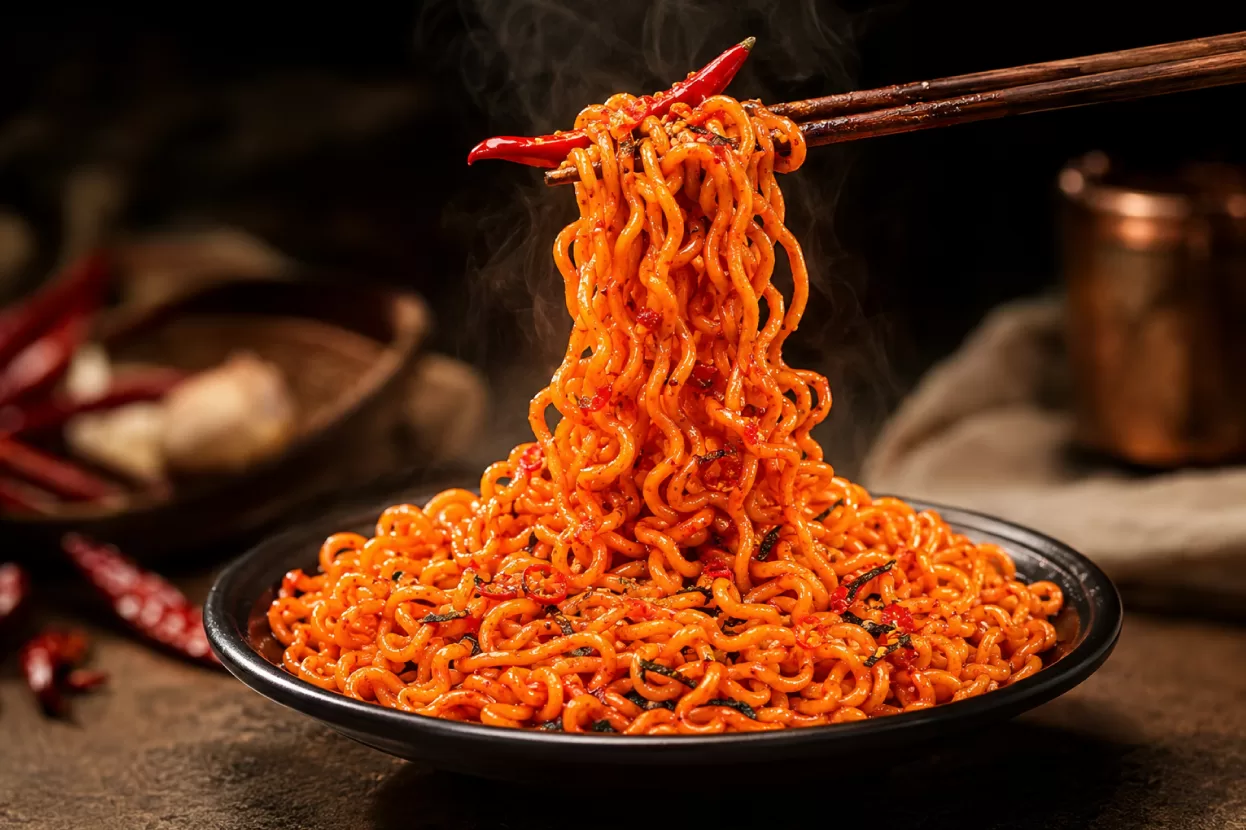
If there is one flavor trend defining the instant noodle category in 2026, it is spicy. Specifically, the Korean-style fire noodle format popularized by Buldak has moved far beyond a viral food challenge and into a permanent, fast-growing category that private label and OEM brands around the world are racing to enter.
This article breaks down why the spicy instant noodle trend has become one of the biggest opportunities in the category right now, what it means if you are a brand, distributor, or retailer thinking about launching your own spicy noodle line, and how OEM manufacturing fits into capturing that demand quickly.
Instant noodles have always been a category defined by convenience and affordability, but the last few years have shown that flavor innovation, not just price or availability, is now what drives growth. According to Fortune Business Insights, Asia-Pacific accounted for over 85 percent of the global instant noodles market share in 2025. But the spicy noodle trend specifically has broken out of that regional pattern and become a genuinely global phenomenon, which is exactly what makes it such a compelling opportunity for brands outside the traditional noodle-consuming markets.
The Numbers Behind the Spicy Noodle Boom
The scale of this trend is not just social media noise. It is backed by real, sustained sales growth.
According to UPI, Samyang Foods, the company behind the original Buldak spicy noodle line, reported annual sales exceeding 2 trillion won (roughly $1.4 billion) for the first time in its history in 2025, a 36 percent jump driven largely by continued demand for its Buldak series. Separately, The Korea Times reports that Buldak ramen alone now accounts for roughly 60 percent of South Korea's total ramen exports, with the company surpassing $900 million in exports in a single year.
This is not a short-lived spike. CNBC reports that South Korean noodle makers are actively expanding overseas because higher average selling prices abroad, sustained cultural momentum from the Korean Wave, and a saturated domestic market are pushing them to chase growth in international markets. In line with that expansion, UPI reports that Samyang is building a new manufacturing plant in Jiaxing, China, and expanding beyond instant noodles into adjacent formats such as sauces and air-dried noodles to meet rising demand.
The takeaway for private label and OEM buyers is straightforward: spicy noodles are no longer a niche or seasonal trend. They are a structural shift in what consumers expect from the instant noodle category, and that shift is happening globally, not just in East Asia.
Why This Trend Is a Real OEM Opportunity, Not Just Hype
A few reasons this trend translates into real commercial opportunity rather than a passing moment:
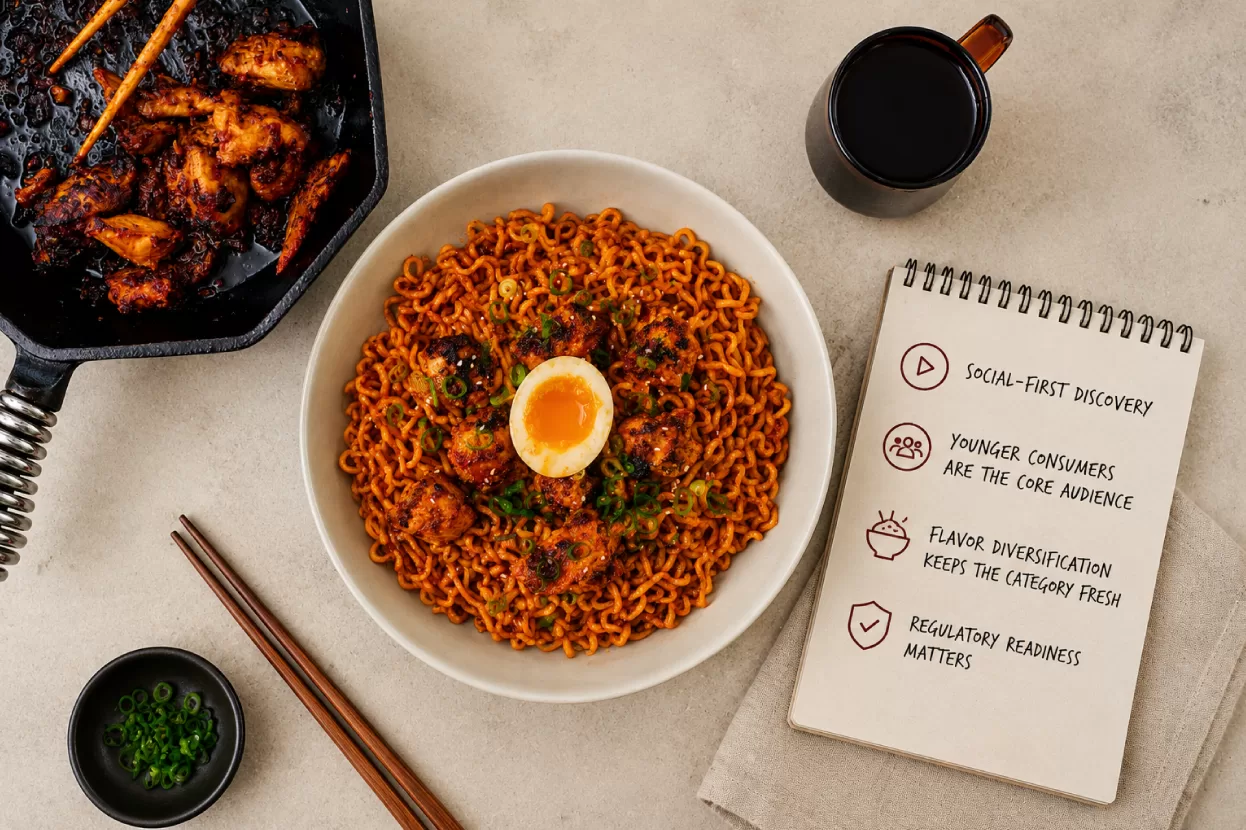
- Social-first discovery. According to ABC News and industry analysis from Accio, the "Fire Noodle Challenge" generated more than a million videos on YouTube and TikTok, contributing to a 126 percent increase in sales for Samyang's U.S. business alone. A well-positioned spicy noodle product can ride existing social momentum instead of building demand from zero.
- Younger consumers are the core audience. The same Accio industry analysis notes that Samyang's influencer and social media strategy is designed to reach Generation Z and Generation Alpha specifically, since these consumers are highly engaged on the platforms driving the trend and are the demographic most likely to try a new brand if the product and packaging feel current.
- Flavor diversification keeps the category fresh. ABC News reports that Samyang itself continues to experiment with variations such as cheese, curry, mala, and carbonara flavours beyond the original extreme-heat format, showing that a spicy noodle line does not have to be extreme to participate in the trend; it needs to be well-positioned within it.
- Regulatory readiness matters. In June 2024, Denmark's food safety authority recalled three Buldak product variants over concerns that their capsaicin levels could cause "acute poisoning," particularly in children. NBC News later reported that two of the three products were reinstated after further testing found the seasoning did not contain the marketed capsaicin levels, while the most extreme variant remained restricted. This is a clear, real-world example of why brands entering this space need a manufacturing partner who understands ingredient and labelling requirements for their target export markets, not just flavour development.
What This Means If You're Considering a Private Label Spicy Noodle Line
For brands, distributors, and retailers evaluating whether to launch a spicy instant noodle product, the current moment offers a rare combination: proven consumer demand, an established flavor category consumers already understand, and enough room for differentiation that a new entrant does not need to compete purely on heat level. If you're still deciding between routes to market, our OEM vs private label comparison breaks down which approach fits your brand's goals.
That said, launching into this category successfully depends on getting a few things right from the start:
Formulation that fits your target market. A spicy noodle product aimed at North American or European consumers will likely need a different heat and flavor balance than one aimed at Southeast Asian or Middle Eastern markets. OEM manufacturing allows you to adjust formulation for your specific audience rather than adopting a one-size-fits-all recipe. If you're still budgeting for this stage, our guide on calculating the true cost of launching an instant noodle brand is a useful starting point.
Packaging and positioning that feels current. Since this trend is driven heavily by social platforms and younger consumers, packaging that looks dated or overly generic will struggle to compete, regardless of how good the product tastes.
Compliance for your export markets. The Denmark recall example above shows that ingredient thresholds and labeling requirements need to be built into the formulation process from day one, not adjusted after the fact, especially for brands targeting regulated markets such as the European Union.
A manufacturing partner that can move at trend speed. Trends built on social platforms can shift quickly. Working with a manufacturer that offers clear, realistic order timelines and well-defined MOQs matters more in a fast-moving category like this than in slower-moving, traditional flavor lines, since it lets brands plan their launch and inventory with confidence from the outset.
How Vit's Supports Brands Entering the Spicy Noodle Category
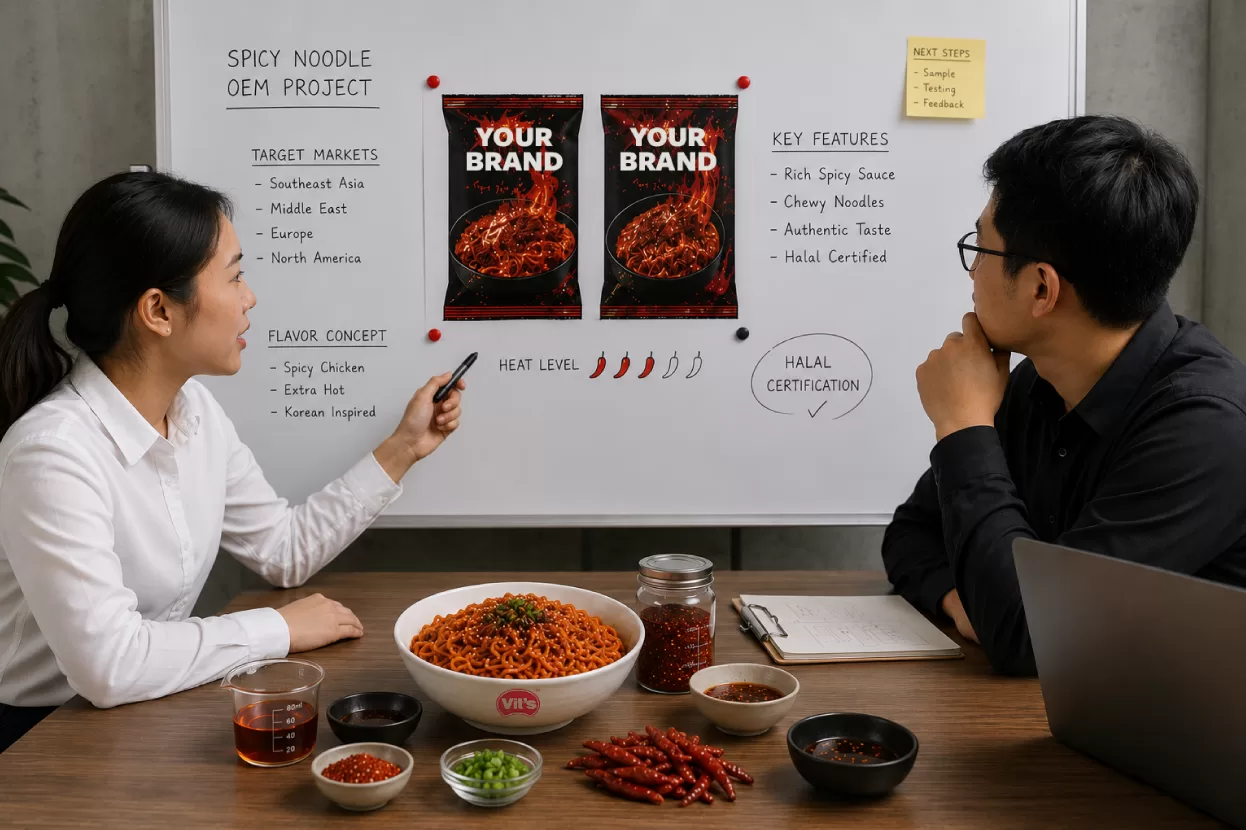
This is exactly the kind of opportunity OEM and private label manufacturing exists to capture. Rather than waiting years to build in-house production capability, brands can move directly from concept to shelf-ready product through a manufacturing partner that already has the infrastructure in place.
Vit's supports brands entering this space with:
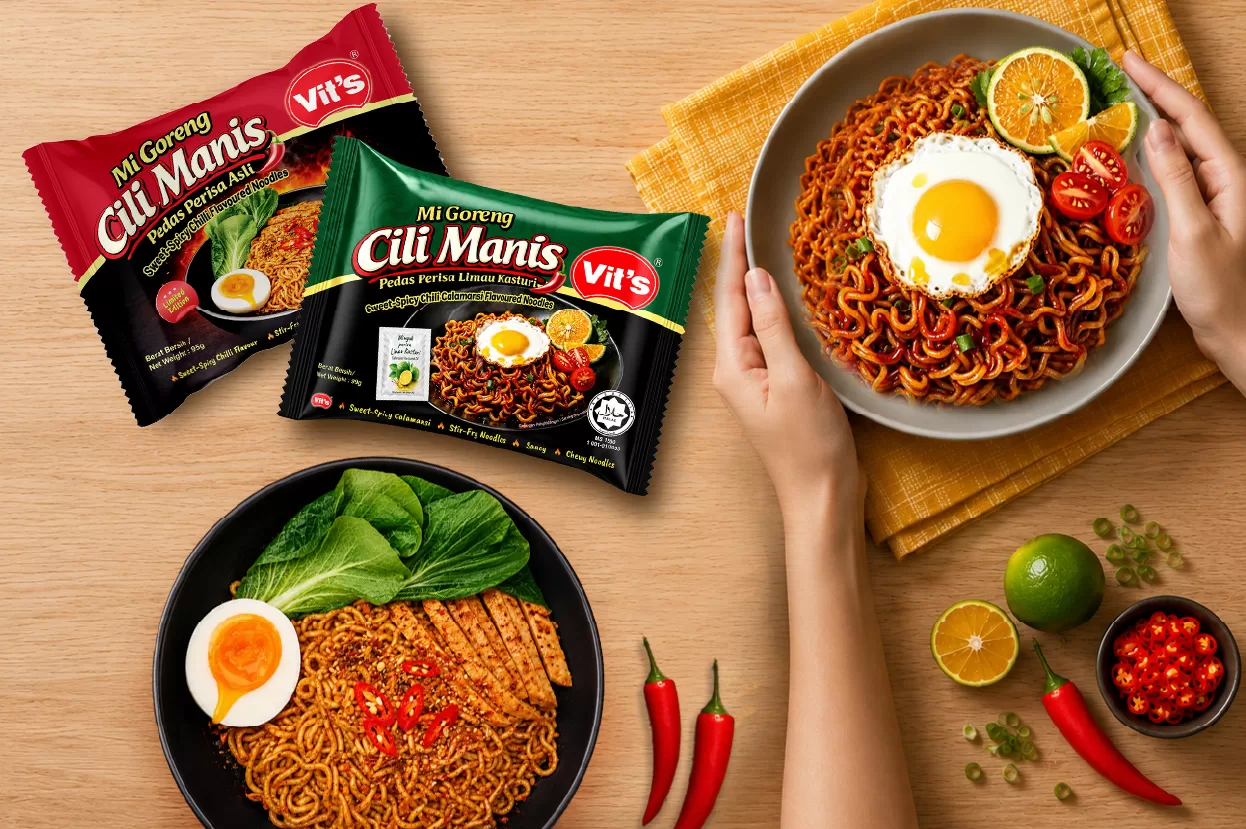
- Custom formulation, including spice level, flavour profile, sauce base, and noodle texture. Our own Mi Goreng Cili Manis Pedas was developed in-house around a sweet spicy chili profile with a saucy, chewy stir-fry noodle, so the same formulation capability is available to brands building their own spicy line.
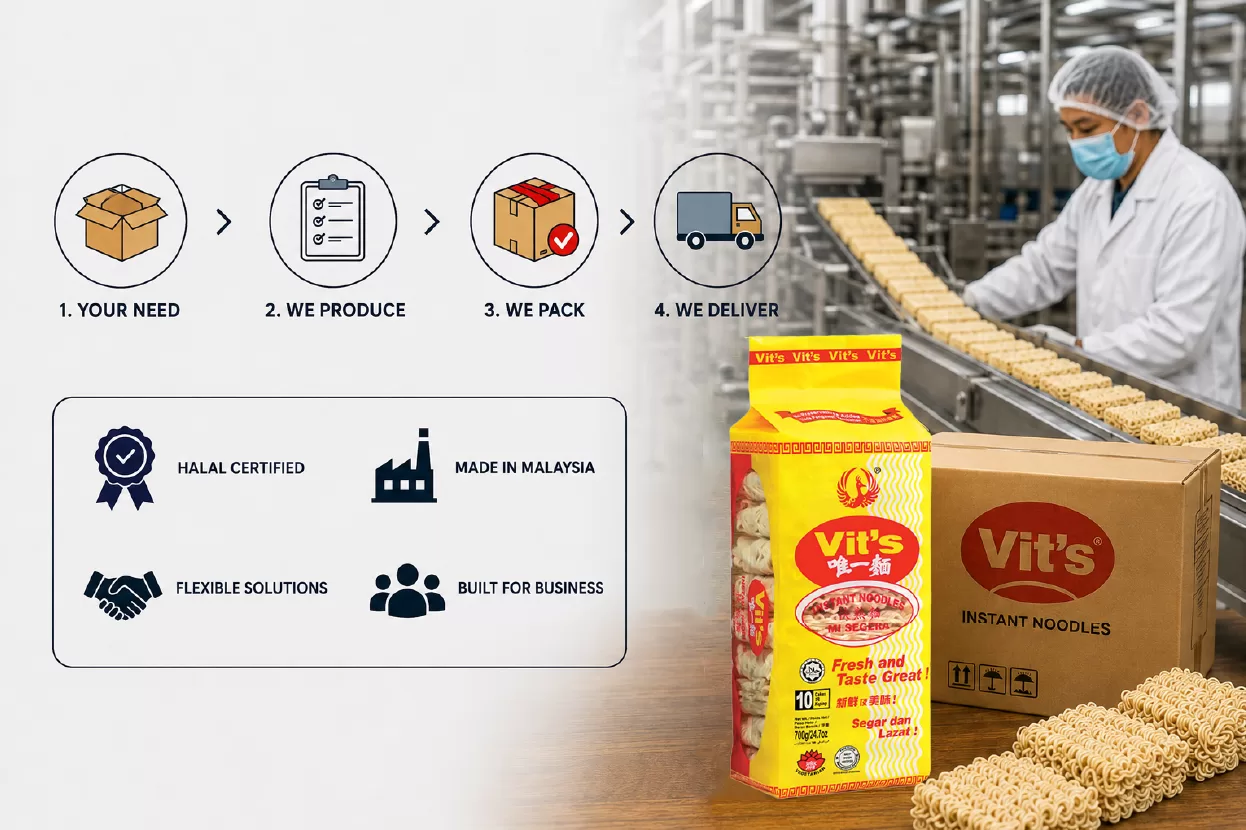
- Halal-certified production, an increasingly important requirement as spicy noodle demand grows in markets across the Middle East and Southeast Asia. Vit's has been Halal-certified since 1980
- Export-ready manufacturing, for brands planning to sell beyond their home market
- Clear OEM order requirements, with a minimum order quantity of 1,000 cartons for OEM production, which may increase depending on the complexity of your formulation and packaging requirements
- Packaging support, helping your product compete visually in a category where shelf and social presence both matter
Whether you are an established F&B brand looking to add a spicy line, a retailer wanting a private label product to ride current demand, or a distributor exploring which spicy noodle products to bring into a new market, the conversation starts the same way: understanding your target market, your volume expectations, and your timeline.
Standing Out in a Category One Brand Already Dominates
Any brand entering the spicy noodle space needs to reckon with one obvious fact: Samyang's Buldak line is not just the trend, it is the benchmark consumers measure everything else against, having crossed 10 billion cumulative units sold and $4.5 billion in cumulative revenue since its 2012 launch. That kind of scale means a new entrant competing head-on for "who is spiciest" is unlikely to win.
The more realistic path for most brands is differentiation rather than direct competition. That can mean:
- Regional flavor fusion. This is not a hypothetical strategy. Indofood's Indomie brand, one of the world's most widely distributed instant noodle lines, has long sold a rendang-flavored Mi Goreng variant that blends the popular Indonesian fried-noodle format with a rich, regionally familiar spice profile, rather than simply imitating a Korean-style heat product. A brand that pairs a trending flavor profile with something familiar to its home market has a built-in advantage that a purely imported product does not.
We took the same approach with our own Mi Goreng Cili Manis Pedas, a sweet spicy chili stir-fry noodle built around a saucy, chewy texture rather than raw heat. Sweet-heat is a flavour profile Malaysian and wider Southeast Asian consumers already recognise, so the product sits inside the global spicy trend without asking consumers to adapt to an unfamiliar taste. For OEM buyers, it is a working example of what a differentiated spicy line can look like: a familiar regional flavour base, a trend-relevant spice angle, and a texture that gives the product its own identity on shelf. - Format innovation. As noted above, UPI reports that Samyang itself is expanding beyond instant noodles into related formats such as sauces and air-dried noodles, suggesting there is room for brands to explore adjacent products rather than competing solely on the classic instant noodle format.
- Milder, more approachable heat levels. Not every consumer wants extreme spice. A private label brand that offers a genuinely well-balanced medium-heat option can capture the large segment of consumers who are curious about the trend but hesitant to commit to the most extreme versions of it.
- Positioning around trust and certification. In markets where Halal certification, clean ingredient labeling, or specific dietary claims matter, a private label brand built around those values can differentiate on more than flavor alone.
Frequently Asked Questions from B2B Buyers
Can a smaller brand realistically compete against Samyang and other major players?
Directly competing on scale or brand recognition is difficult, but there is real opportunity in differentiation, such as regional flavor fusion, more approachable heat levels, or positioning around certification and ingredient quality. Indomie's rendang-flavored noodle line is a real example of a brand succeeding by pairing a trend with a regionally distinct flavor rather than copying the market leader directly.
Are there any regulatory risks I should be aware of when formulating a spicy noodle product?
Yes. Denmark's 2024 recall of three Buldak variants over capsaicin levels, later partially reversed after further testing, is a documented example of how spice level and labeling accuracy can trigger regulatory action in certain markets. Working with a manufacturer who understands the regulatory requirements of your target export markets from the start of formulation helps avoid costly reformulation or compliance issues later.
Does this trend only apply to instant noodles, or could it extend to other product formats?
The underlying flavor trend, bold Korean-style spice, has already started extending into other formats. Samyang itself has announced plans to expand into sauces and air-dried noodles alongside its core instant noodle range. Brands exploring this space may want to consider whether a spicy sauce or seasoning product could complement a private label noodle line.
Is the spicy noodle trend still growing, or has it already peaked?
Sales data suggests continued growth rather than a plateau. Samyang's overseas sales and export figures both grew significantly year on year through 2025 and into 2026, and the company is actively expanding production capacity in China rather than pulling back.
What is the minimum order quantity for an OEM spicy noodle product?
The MOQ for OEM production is 1,000 cartons, and this may increase depending on the complexity of your formulation, packaging, and any custom requirements. It's best to discuss your specific product concept early on so we can give you an accurate quantity and cost estimate before you commit.
Has Vit's developed a spicy noodle product of its own?
Yes. Mi Goreng Cili Manis Pedas is our sweet spicy chili stir-fry noodle, developed around a saucy sauce base and chewy noodle texture rather than an extreme heat level. It is a practical demonstration of the formulation approach we can apply to an OEM or private label project, including sweet-heat balance, sauce consistency, and noodle bite.
Ready to Explore a Spicy Noodle Line?
The spicy instant noodle trend is one of the clearest examples in recent years of a flavor category moving from viral moment to permanent shelf staple. Brands that move now, with the right formulation and the right manufacturing partner, have a real opportunity to capture demand that shows no sign of slowing down.
If you're exploring a spicy or Buldak-style private label noodle product, reach out to our team to talk through formulation options, target markets, and timelines.