
If you are thinking about launching your own noodle brand in Malaysia, you have almost certainly come across two terms: OEM and private label. Both describe ways of working with a noodle manufacturer to bring a product to market, and both are legitimate business models. But they work very differently, and the one you choose has significant implications for your brand ownership, your cost structure, your route to market, and your ability to compete and grow over time. Understanding the distinction before you commit to a manufacturing partner is one of the most important decisions you will make as a food brand.
This article breaks down exactly what OEM and private label mean in the context of noodle manufacturing, compares the two approaches across the dimensions that matter most, and gives you a clear framework for deciding which model fits where your business is today and where you want it to go. If you are ready to explore your options, you can also visit our OEM manufacturing page and private label services page directly.
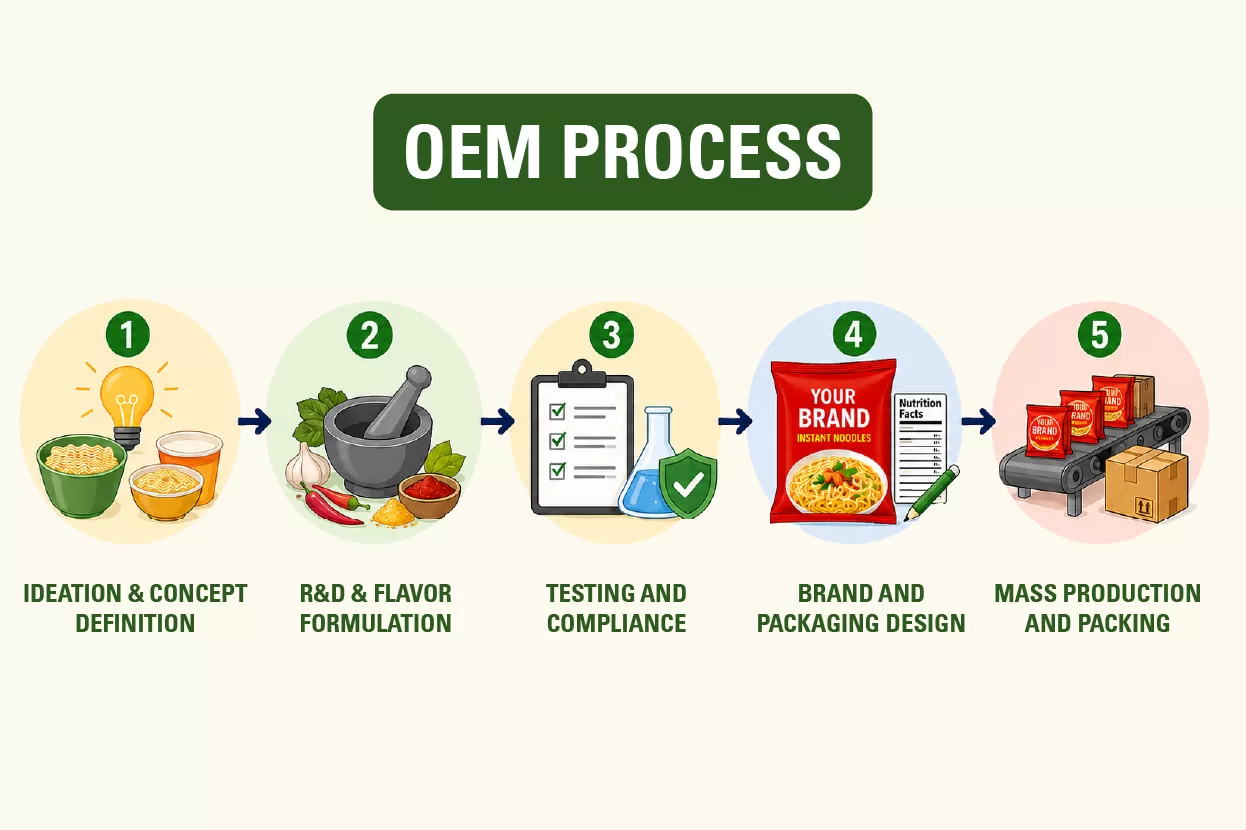
What Is OEM Noodle Manufacturing?
OEM stands for Original Equipment Manufacturer. In the food industry, OEM manufacturing means the factory produces a product according to your exact specifications. Your recipe. Your defined ingredients and quality standards. Your flavour profile and texture requirements. The manufacturer provides the production facility, the technical capability, the equipment, and the workforce. You provide the product vision, and together you bring it to life at commercial scale.
Under a genuine OEM arrangement, you control the recipe fully. You define the noodle type and thickness, the flour blend, the moisture content, and the texture target. You specify the seasoning formula, the flavour intensity, and the ingredient sourcing standards you require. You set the nutritional targets and the packaging format. Because all of these specifications belong to you, the resulting product belongs to you. If you ever decide to change manufacturing partners, you take your recipe and your formulation with you. The intellectual property remains yours, not the factory's. This is an important point worth protecting formally, and the Intellectual Property Corporation of Malaysia (MyIPO) provides guidance on registering and protecting proprietary food formulations.
OEM is the manufacturing model behind most of the noodle brands you recognise on Malaysian supermarket shelves and in export markets across ASEAN and the Middle East. Brands that have invested in OEM manufacturing have something their private label competitors cannot easily replicate: a product that is entirely and exclusively theirs.
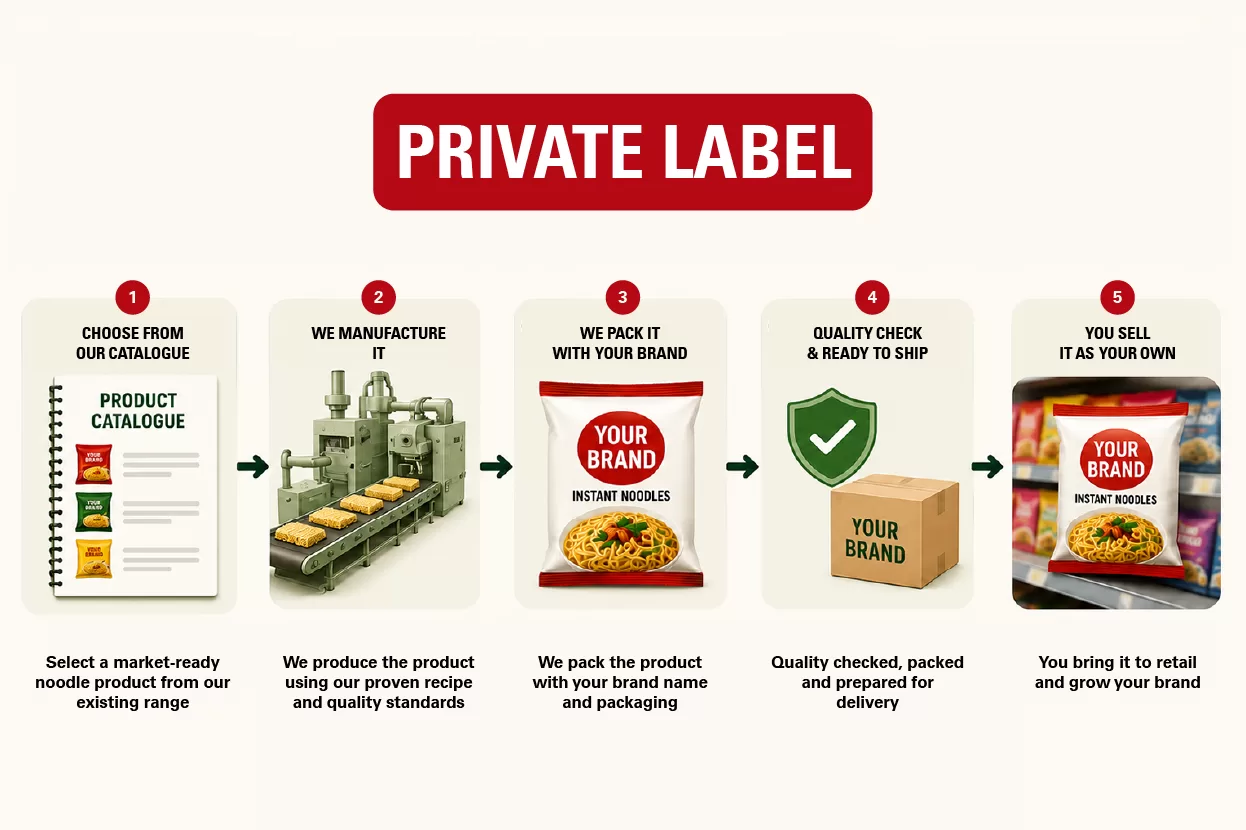
What Is Private Label Noodle Manufacturing?
Private label works in the opposite direction. Rather than developing a product from your specifications, the manufacturer already has a finished, market-ready product. They have developed the recipe, tested the formulation, and have an existing production run available. You choose a product from their catalogue, put your brand name and packaging on it, and bring it to retail.
In a private label arrangement, the manufacturer retains ownership of everything that matters to the product itself: the recipe, the ingredient sourcing, the formulation decisions, and the production process. What you own is your brand presentation, your packaging design, your pricing strategy, and your distribution. The noodle inside the packet is the manufacturer's product, not yours. Other brands using the same manufacturer may be selling a product that is essentially identical to yours, with different packaging and a different price point.
Private label is popular with retailers building house brands, entrepreneurs who want to test market demand before committing to full product development, and businesses that need to reach shelf quickly without the time or capital investment that OEM requires. It is a legitimate entry point, and for certain business models it makes perfect sense. The important thing is going in with a clear understanding of what you own and what you do not. You can learn more about how Vit's structures its private label service here.
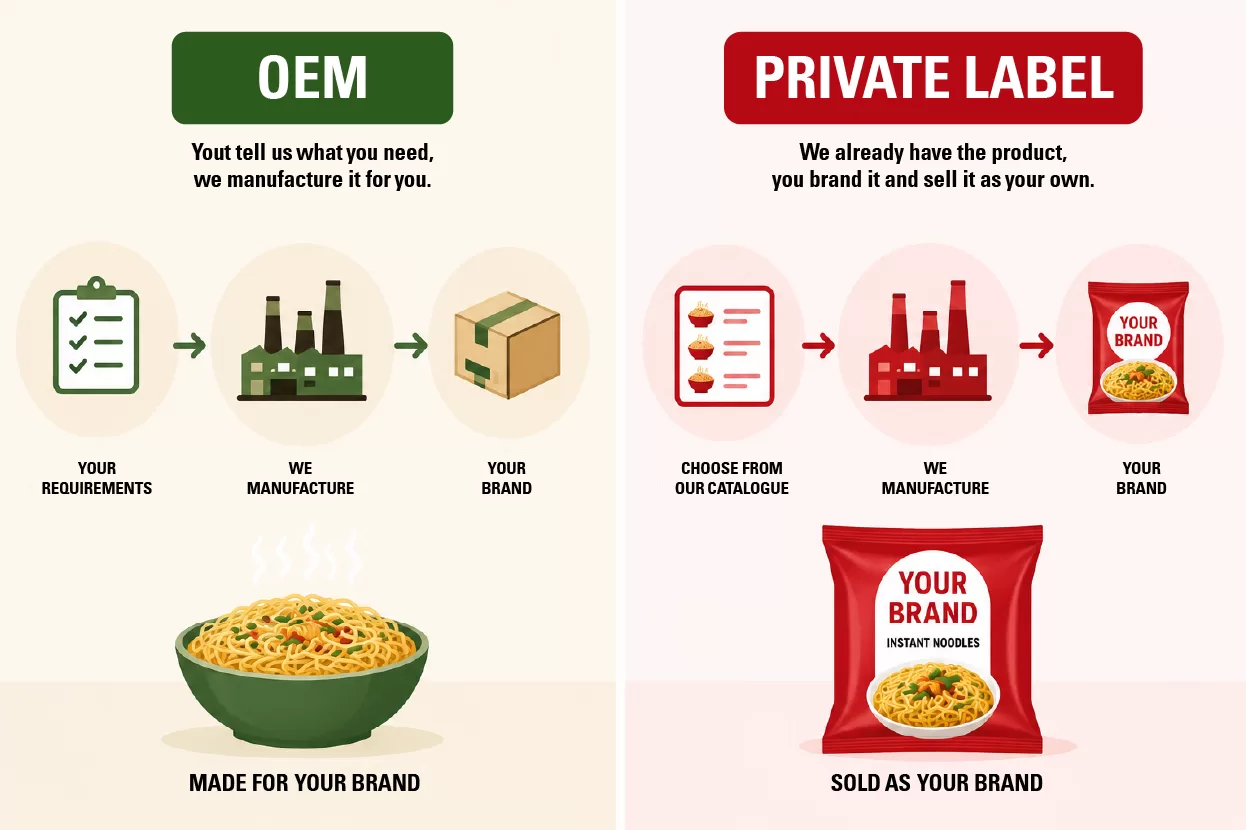
OEM vs Private Label: How the Two Models Compare
The differences between OEM and private label touch almost every dimension of running a food brand. Here is a direct comparison across the factors that matter most when you are making this decision.
Product Ownership and Intellectual Property
This is the most fundamental difference between the two models. With OEM, the recipe is yours. You developed it, or you developed it in partnership with the manufacturer's R&D team, and you own the formulation. With private label, the recipe belongs to the manufacturer. This sounds abstract until the moment it becomes very concrete, which is typically when your product gains real traction in the market and you realise you have no legal claim to the thing your customers love. Malaysia's Intellectual Property Corporation (MyIPO) provides routes for protecting proprietary formulations and trade secrets, which is a step OEM brand owners should consider early.
Customisation and Differentiation
OEM gives you full control over every element of the product. You can specify the exact thickness of the noodle, the precise balance of flavours in the seasoning, the texture at the point of consumption, and any functional or nutritional claims you want to build into the formulation. Private label typically offers limited customisation. You may be able to adjust packaging or choose between a handful of existing flavour variants, but the core product is the manufacturer's, and significant changes to the formulation are usually not available.
Time to Market
Private label wins on speed. The product already exists and has already been tested. You can move from initial agreement to finished stock in a matter of weeks. OEM requires recipe development, formulation testing, consumer feedback cycles, and regulatory review before you have a finished product. This process typically takes several months. That investment of time is not a disadvantage, it is the cost of building something that is genuinely yours. But if speed to market is your primary constraint, private label has an obvious advantage in the short term.
Investment and Minimum Order Quantities
Private label generally requires lower upfront capital. There are no development costs because the product already exists, and minimum order quantities can sometimes be lower. OEM involves investment in R&D, formulation development, and often higher initial production runs. However, the economics shift as your brand scales. OEM gives you more control over your ingredient costs and production efficiency over time, and the absence of a margin layer that many private label arrangements include can make OEM more cost-effective at volume.
Scalability and Export Readiness
Brands looking to scale beyond Malaysia, into Singapore, Indonesia, the Middle East, or further international markets, almost always need OEM manufacturing. Export buyers, retail chains, and distributors in other markets want to know they are carrying an exclusive product. A product that is available to any brand willing to put their logo on it is not a differentiated product. OEM is the foundation that makes regional and international brand building possible in a credible way. The Malaysian Investment Development Authority (MIDA) also offers guidance and incentives for food manufacturers looking to grow their export footprint, which is worth exploring as your brand scales.
The Risk That Catches Private Label Brands Off Guard
Here is a situation that plays out more often than it should in the food industry. A brand launches on private label, builds distribution, invests in marketing, and develops genuine consumer loyalty around their product. Then the manufacturer changes the formula without adequate notice, or increases production costs significantly because they know the brand has limited alternatives, or begins supplying essentially the same product to a new competitor at a lower price. At that point, the brand has a serious problem that it has no clean way to solve, because the product it built its reputation on does not legally belong to it.
Rebuilding consumer confidence after a forced product change is genuinely difficult and expensive. Moving to OEM manufacturing under pressure, rather than by choice, costs significantly more and takes significantly longer than it would have at the outset. These are not theoretical risks. They are the natural consequences of building a brand on a product you do not own, and they are worth considering seriously before you commit to a private label arrangement for a product you intend to grow.
Private label is not a bad model. But it is a starting point, not a long-term foundation for brands that are serious about building equity, protecting margin, and scaling with confidence.
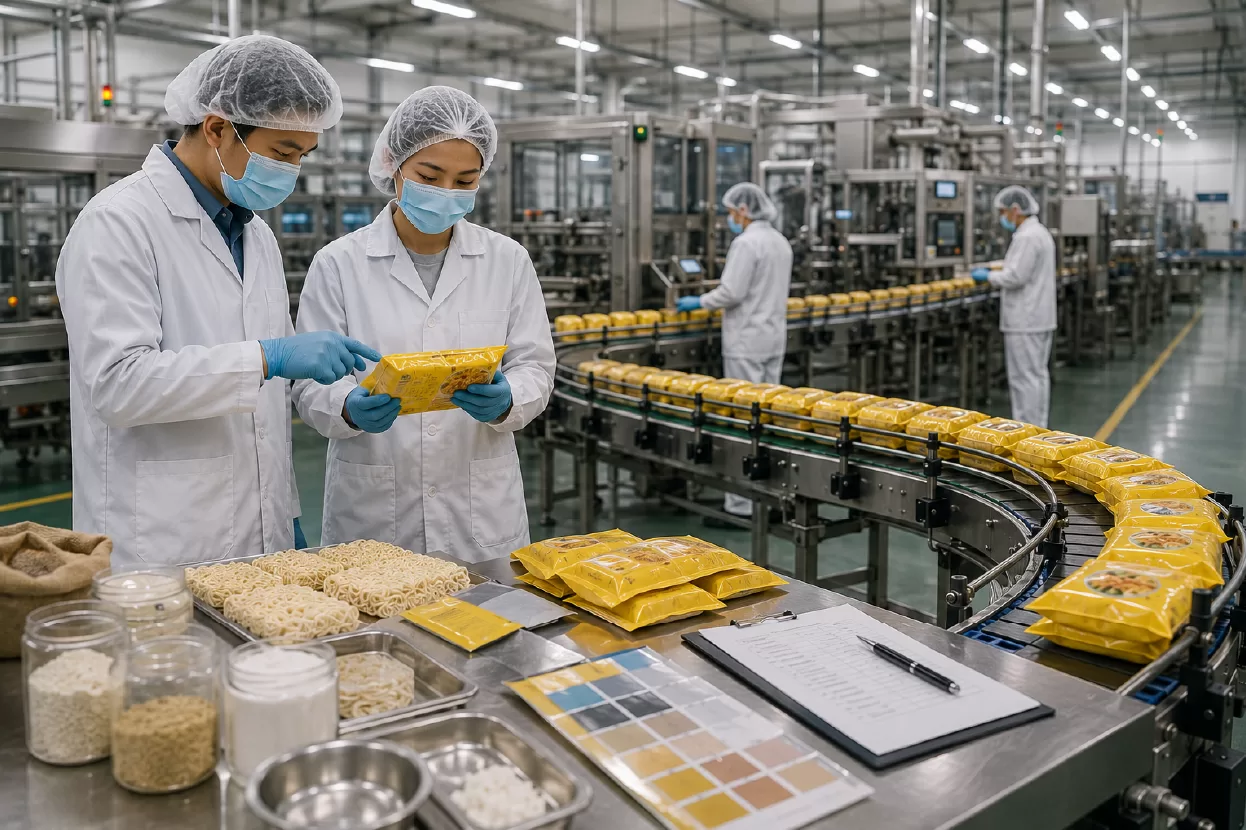
How Vit's Supports OEM Noodle Brand Development
At Vit's, we have spent decades producing noodles that Malaysian consumers trust. That depth of manufacturing experience is what we bring to the brands we partner with through OEM production. We work with businesses at different stages of development, from brand owners who arrive with a fully developed recipe and need a manufacturer that can execute it consistently at scale, to entrepreneurs and food businesses who have a product direction but need our in-house R&D team to help develop and refine the formulation into something production-ready.
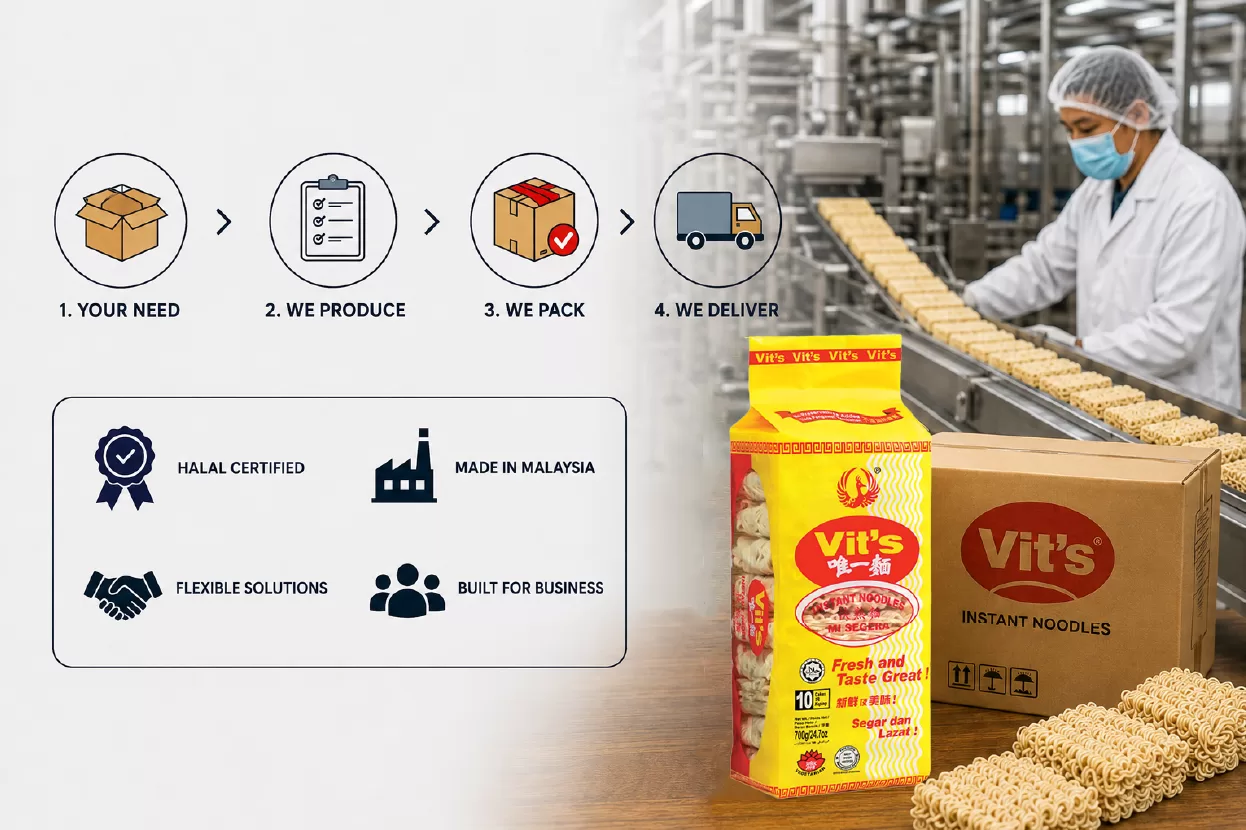
Our OEM partners benefit from flexible production capacity that scales alongside their brand's growth, halal-certified manufacturing with full supply chain traceability, technical expertise across instant noodle formats as well as dry noodles and specialty varieties, support for packaging development and regulatory compliance for both domestic and export markets, and a manufacturing team that understands what it takes to produce a product that performs reliably on shelf and satisfies consumers consistently.
We also understand that choosing an OEM manufacturing partner is one of the most consequential decisions a food brand makes. It is not simply a supplier relationship. It is a production partnership that shapes your product quality, your cost structure, your speed to market, and ultimately the reputation your brand builds with consumers. We take that responsibility seriously, and we invest in the relationships we build with the brands we manufacture for.
Vit's holds halal certification, FSSC 22000, HACCP, and GMP accreditation, all of which you can verify on our certifications page. These are not box-ticking exercises. They are the quality and compliance infrastructure that makes it possible for OEM partners to sell into regulated retail and export markets with confidence.
If you are exploring OEM noodle manufacturing in Malaysia for your brand, we welcome the conversation. Contact the Vit's team to discuss your product requirements and how we can help bring your vision to market.
Which Model Is Right for Your Brand?
If you are purely at the testing stage and need to validate market demand before committing significant capital, private label can be a reasonable first step, provided you go in understanding what you own and what your exit looks like when you are ready to move to something proprietary. Use it to learn the market, build your distribution relationships, and refine your brand positioning. Then plan your transition to OEM once you have the confidence and the capital to build a product that is genuinely yours.
If you are building a brand for the medium to long term, one that you intend to scale across Malaysia, export to regional markets, or develop real consumer loyalty around, OEM manufacturing is the only model that gives you a foundation worth owning. The brands that have built lasting positions in the Malaysian noodle market did not get there by repackaging generic formulas. They got there by owning their product, protecting their recipe, investing in consistency, and giving consumers a reason to choose them that competitors could not easily copy. That is what OEM manufacturing makes possible, and it is the model that Vit's is built to support.
If you have questions about OEM versus private label noodle manufacturing or want to understand what a manufacturing partnership with Vit's looks like in practice, reach out to our team. We are happy to walk you through the process and help you think through the right structure for your brand.