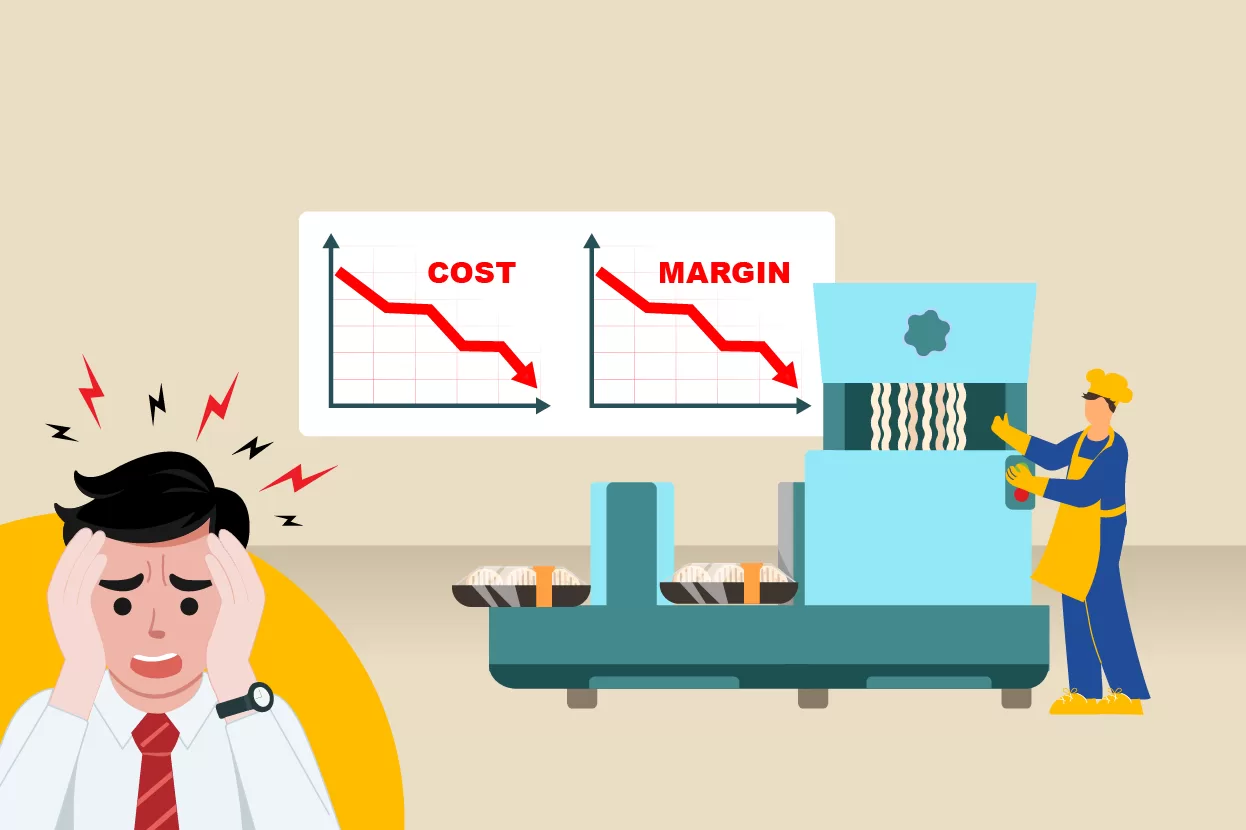
When brands explore OEM or private label manufacturing, one question almost always comes up early in the conversation: “Who can give us the lowest manufacturing cost?” On the surface, this feels logical. Lower production cost should mean higher profit. However, in practice, brands that prioritise the cheapest manufacturing option often experience the opposite outcome, including shrinking margins, operational issues, and long-term growth limitations.
In food manufacturing, particularly in categories like noodles, the lowest unit cost rarely translates into the best business margin. True margin is shaped not only by what you pay per unit, but by everything that happens before, during, and after production.
Understanding this difference is critical for brands that want to scale sustainably rather than focus on short-term cost savings.
Manufacturing Cost Is Only One Part of the Margin Equation
Manufacturing cost refers to the price paid per unit to produce a product. Margin, however, is what remains after all related costs are considered. These include logistics, wastage, quality control, compliance, inventory holding, rework, delays, and even lost sales caused by inconsistent supply or product performance.
A manufacturer offering the lowest quotation may reduce the cost per carton, but if that same manufacturer causes frequent delays, inconsistent quality, or higher wastage, the brand ends up paying far more over time. These additional costs are often not visible during the quotation stage, which is why they are frequently underestimated.
Brands that focus only on unit price tend to optimise the wrong metric. Margin is not built at the quotation stage. It is protected through operational consistency and efficiency over time.
At Vit’s Noodle, we often see brands improve margins not by switching to the cheapest option, but by working with a manufacturer that helps reduce operational friction and hidden costs across the supply chain. Streamlined supply chains are crucial for reducing costs, improving efficiency, and managing disruptions in production and delivery processes.

The Hidden Costs Behind the Lowest Manufacturing Price
One of the main reasons the lowest manufacturing cost fails to deliver strong margins is the accumulation of hidden costs. These costs do not appear clearly on invoices, but they quietly erode profitability.
Quality inconsistency is one of the most common challenges. Manufacturers operating at extremely low margins often rely on cheaper raw materials, limited quality checks, or unstable processes. While the product may pass basic inspection, small inconsistencies can lead to customer complaints, negative reviews, and lower repeat purchase rates. For food brands, this directly affects brand trust and lifetime customer value.
Wastage and rework also play a significant role. Poor process control often results in rejected batches, inefficient yields, or inconsistent output. Each rejected batch means wasted ingredients, additional labour, and lost production time. Over multiple production cycles, these losses can exceed any savings gained from a lower unit price.
Supply chain reliability is another overlooked factor. Ultra low cost manufacturers may lack buffer capacity, reliable supplier relationships, or strong production planning systems. This increases the risk of delays, ingredient shortages, or last minute schedule changes. Brands then face stockouts, missed sales opportunities, or expensive emergency logistics, all of which reduce overall margin.
In food manufacturing, regulatory compliance is a non-negotiable requirement. Manufacturers that cut costs aggressively may invest less in food safety systems, audits, or documentation. This exposes brands to launch delays, restricted market access, or compliance risks. In the worst cases, recalls or penalties can cause long lasting damage that far outweighs any initial cost savings.
Vit’s Noodle places strong emphasis on food safety, regulatory compliance, and consistent quality control because we understand that margin protection starts with risk reduction, not just cost reduction.

Why Cheap Manufacturing Often Limits Growth
Beyond immediate cost implications, choosing the lowest cost manufacturer can create structural challenges that limit a brand’s ability to scale. Scalability is a common constraint. Many low-cost manufacturers can support small volumes but struggle as demand increases. As brands grow, they may encounter longer lead times, inconsistent output, or capacity bottlenecks. At that point, brands are forced to slow down growth or change manufacturers, both of which are costly and disruptive.
Switching manufacturers during a growth phase is rarely straightforward. It often involves reformulation, packaging changes, new quality validations, and fresh regulatory submissions. These transitions consume significant time, money, and internal resources, all of which can negatively impact margins. When manufacturers are changed, replicating the same taste, texture, or product performance is never guaranteed. This often requires additional R&D efforts to resolve inconsistencies that arise during production, ultimately slowing momentum and increasing operational risk.
Low-cost manufacturing relationships also tend to be transactional, with limited collaboration on improving formulations, optimising processes, or planning for long-term growth. As a result, brands miss opportunities to improve efficiency and reduce total cost over time. This lack of partnership ultimately limits a brand’s ability to refine formulations, optimise production workflows, and build meaningful product differentiation in an increasingly competitive market.
At Vit’s, we take a consultative approach that supports brands beyond initial production. By planning for scalability early, brands avoid costly transitions and maintain consistency as they grow.

What Actually Drives Better Manufacturing Margins
Brands that consistently achieve strong margins approach manufacturing decisions differently. Instead of asking who is cheapest, they focus on who can deliver the best total value.
Reliable quality is one of the strongest margin drivers. When products are consistent, brands benefit from fewer complaints, stronger customer trust, and higher repeat purchase rates. This reduces marketing costs and increases customer lifetime value.
Operational efficiency also has a significant impact. Manufacturers with structured processes, automation, and strong yield control reduce wastage and keep costs predictable. Even if the unit price is slightly higher, the cost per sellable unit is often lower.
Speed to market is another important factor. Manufacturers that can move efficiently from development to pilot runs and then to scale allow brands to capture demand earlier. Delayed launches represent lost revenue, which is a hidden cost that is rarely factored into manufacturing decisions.
Most importantly, strategic partnership improves margins over time. Manufacturers who understand a brand’s positioning and growth goals can suggest improvements in formulation, ingredients, or production methods that reduce total cost and improve profitability in the long run.
This is where Vit’s Noodle differentiates itself. We work closely with brands to optimise manufacturing decisions as the business evolves, rather than focusing only on the first order or initial quotation.
Taking a More Strategic View of Manufacturing Cost
Rather than chasing the lowest manufacturing price, successful brands evaluate total cost of ownership. This includes quality stability, supply reliability, compliance strength, scalability, and long term collaboration.
In many cases, paying slightly more per unit to work with a capable and reliable manufacturer results in stronger margins because risks are reduced, operations run more smoothly, and growth is supported rather than constrained.
This approach is especially important for private label and OEM brands planning regional or international expansion, where consistency and compliance become even more critical.
A Smarter Way to Protect and Grow Your Margin
The lowest manufacturing cost may look attractive at the quotation stage, but it rarely delivers the strongest margin over time. Hidden costs, operational risks, and growth limitations often outweigh initial savings.